Pressure, denier and size
Druk en maat
The three numbers this site publishes about a garment: denier, pressure and size. What each of them measures, and what none of them promises.
This page carries the non-medical statement in full. It also appears on every support product page and at checkout.
Last updated 15 August 2026
01These are not medical devices
Fixed statement
These are not medical devices. They are not intended to treat, prevent or relieve any medical condition. If you have a circulatory condition, or if a clinician has advised compression, talk to them about medical compression garments instead.
Compression and legwear are easy to confuse, so this is worth being blunt about. A garment becomes a medical device when it is intended by its manufacturer for a medical purpose — treating, preventing, alleviating or monitoring a condition. That intention is what pulls a product into Regulation (EU) 2017/745, with the conformity assessment, technical documentation and CE marking that follow.
We do not have that intention and we do not make that claim. Nothing on this site is offered to treat, prevent or relieve anything. The category is called Support rather than anything medical, and it is called that on purpose.
If a clinician has advised compression, or if you have a circulatory condition, talk to them about medical compression garments. Those are a different product, sold through a different channel, with a fitting process we do not provide.
02What a pressure value in mmHg is
Three styles here are knitted with a higher elastane content and a graded course structure, so the fabric is firmer through the ankle than the thigh. That gradient is what graduated means. The number we publish is the pressure measured at the ankle, in millimetres of mercury.
- Support 12–15
- 12–15 mmHg at the ankle · 40D · $32.00
- Support 15–18
- 15–18 mmHg at the ankle · 70D · $38.00
- Travel Support 12–15
- 12–15 mmHg at the ankle · 40D · $22.00
What it tells you
- How firmly the fabric holds at the ankle.
- That the hold decreases up the leg, rather than being even.
- Roughly how much effort it takes to pull on. Higher numbers are noticeably harder.
What it does not tell you
- Anything about health, circulation or symptoms.
- Anything about how the garment will feel after eight hours — that depends on your leg, not on the number.
- Anything comparable to a medical compression class. Those classes are defined under separate standards and we do not use them.
People often wear these on long flights or long days on their feet. That is a description of when they are commonly worn, and it is as far as we will go.
03The confirmation before you can buy one
A support style cannot be added to the cart until you have actively confirmed that you have read the statement above. The add-to-cart button stays disabled until then. It is not a dismissible notice that appears after the fact.
At checkout the confirmation is asked for again, as a separate tick from the privacy agreement, and the order will not proceed without it. The server checks it a second time, so the gate is not only in the browser.
Product photography for these styles shows the same display leg form as everything else. There are no clinical settings, no clinicians, no hospital imagery and no illustrations of leg conditions anywhere on this site.
04How denier is measured and photographed
Denier is a measure of linear mass density: the mass in grams of 9,000 metres of yarn. A higher number means a heavier yarn, which in a knitted leg means less light passes through.
It is a good number and it is badly used. Two pairs at the same denier can look very different depending on finish, knit structure and how far the fabric is stretched on the body. So we publish the number and, next to it, a photograph made to a fixed standard.
- Standard
- PS-01
- Subject
- One display leg form, the same one in every photograph. No person, no face, no torso.
- Light
- One soft key at 45° from camera left. No fill, no rim. 5200 K.
- Distance
- Fixed. Never adjusted between styles.
- Background
- One seamless paper.
- Retouching
- Dust removal only. Transparency and finish are never adjusted.
Transparency is also described in words on every product page — skin clearly visible, skin tone visible, details muted, no skin visible — because a photograph alone is not accessible to every reader and because a screen is not a calibrated device.
We do not describe transparency with subjective words. The full ladder is on the denier page.
05Why sizing here has two axes
Tights have to fit a height and a body at the same time. A single S, M or L can only describe one of those, and the mismatch is the largest single cause of returns in this category.
So every style is sized on a matrix: height against weight, or height against hip. Where a body falls outside the regular block there are three dedicated blocks — Tall for length, Curve for a wider body panel, Wide-calf for knee-highs.
Between two cells
The ranges overlap on purpose. If you land in two cells you get both, with what each one costs you: the lower size will be more sheer at the thigh because the same yarn is stretched further; the upper size may bag at the ankle.
Outside every cell
If your measurements fall outside every cell in every block, the matrix says so. We would rather tell you that than sell you something that will ladder on the first wear.
Open the size matrix or describe the problem you are having. The size help form does not provide, and is not a substitute for, medical advice of any kind.
06Snagging, silicone and appearance
Snagging
A finer yarn catches more easily. A tighter knit at 70D resists snagging better than at 15D, but no tights are snag-proof and we will not describe any of them that way. Reinforced toes and heels move where wear happens; they do not remove it.
Silicone bands
Silicone bands hold better on dry skin. Lotions and oils reduce grip. They reduce slipping; they do not eliminate it.
Appearance
A higher elastane content through the thigh gives a firmer hold. That is a statement about the fabric. We make no claim that any garment on this site changes the shape or the appearance of a body, and nothing here is sold on that basis.
07The three support styles
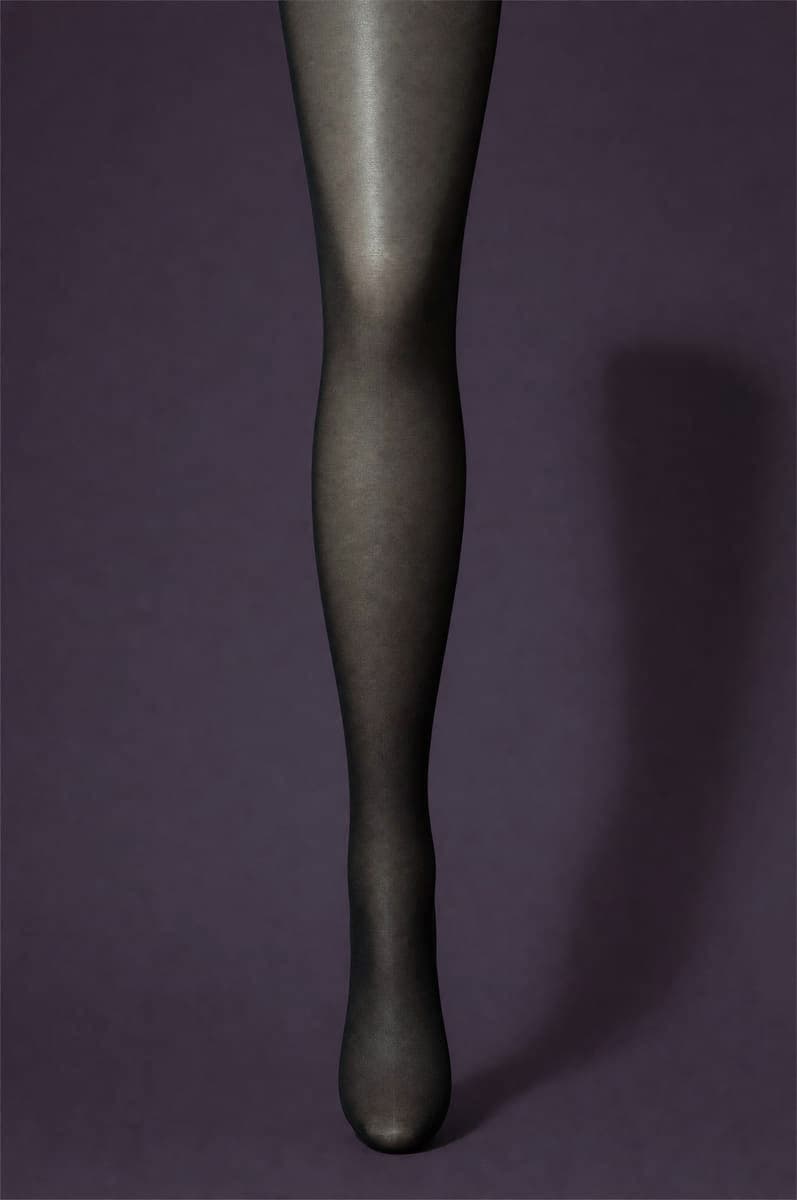
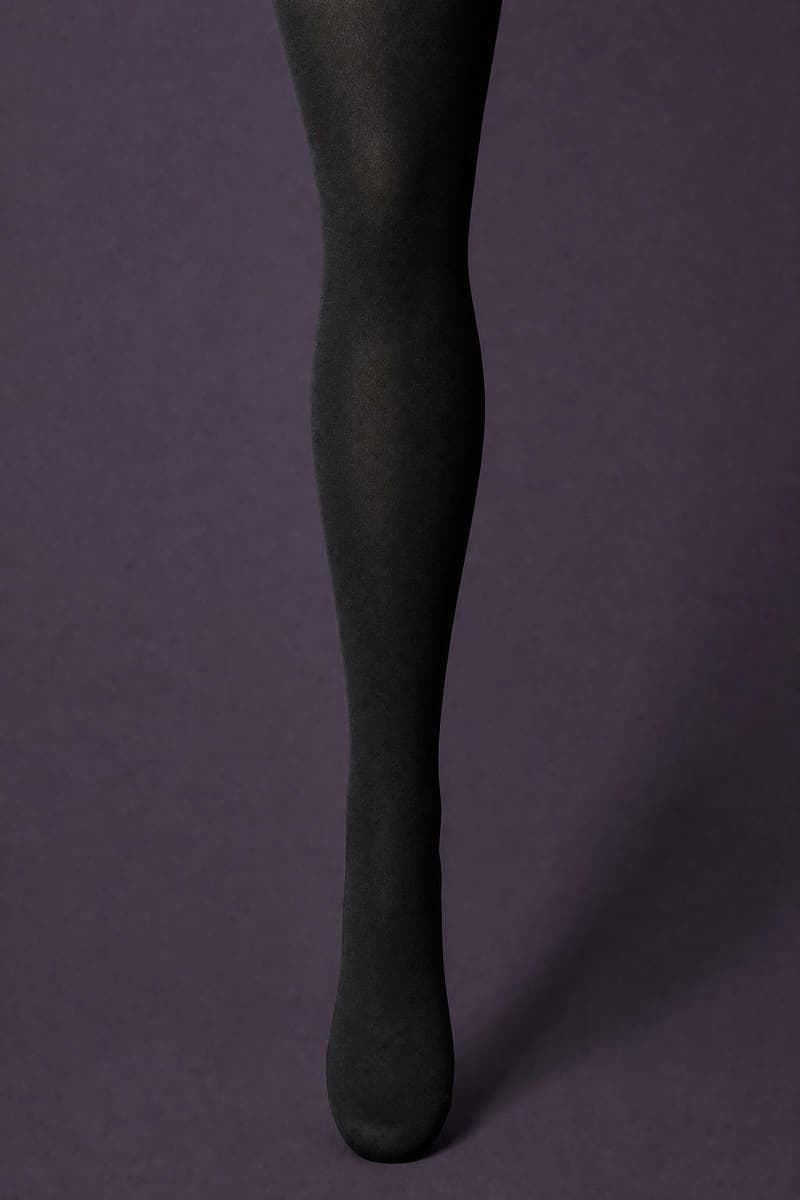
12–15 mmHg · 40D · $22.00
Knee-high graduated compression, 12 to 15 mmHg. Not a medical device.
All three are knitted with the same graded structure and differ only in pressure value and coverage.
The category boundary is also stated on the statutory information page and in the terms and conditions.